Witness

Updated 5 May 2020

Updated 20 Jan 2026

6 Oct 2018, 9:59 AM

No matter what happens with Kavanaugh, despair is not an option. Channel your angry energy into action. Call. Demonstrate. Register. Vote. There will be devastating losses along the way, and from them we recover and learn. We’re taking this fucking country back. Keep going.

6 Oct 2018, 10:59 AM

Older woman crying in photo: “How are we going to find the strength to keep fighting? Are we going to be out here for another 30 years? I don’t have 30 years left.”

Younger woman taking her photo: “I’ll be here. I’ll keep fighting.”

6 Oct 2018, 11:03 AM

NEW: Ramirez statement:
‘The other students … chose to laugh and look the other
way as sexual violence was perpetrated on me by (BK). As I watch many
of the Senators speak & vote … I feel like I’m right back at Yale where half the room is laughing and looking the other way.’

6 Oct 2018, 12:56 PM

Protesters have climbed the stairs of the Capitol chanting “November is coming!”. Hundred present here and across the street in front of SCOTUS.

6 Oct 2018, 1:12 PM

Thousands of anti-Kavanaugh protestors chanting “Vote them out!” Dozens being arrested on East Capitol steps now

6 Oct 2018, 3:46 PM

The screams from the protestors in the Senate are primal.

6 Oct 2018, 4:05 PM

https://twitter.com/ChuckWendig/status/1048665516699803649

There will be renewed calls for civility. Ignore them. They ask for civility as a way for you to grant them complicity in what they do.

Kavanaugh’s appointment isn’t a step backward. It’s a head-first plunge into an ugly past

6 Oct 2018, 5:48 PM

“What we are witnessing is not a step backwards for America so much as a headlong plunge into a punitive past. Adults must fight this future for the sake of the youngest Americans, who have already lost more than they ever got the chance to know.”

6 Oct 2018, 6:23 PM

What I hope people grasp is that the fight is not only about the win. You fight because it’s the right thing to do. You fight because if it alleviates suffering for just one person, it’s worth it. You fight because if you don’t, if you let them define you, you will lose yourself.

Updated 5 May 2020

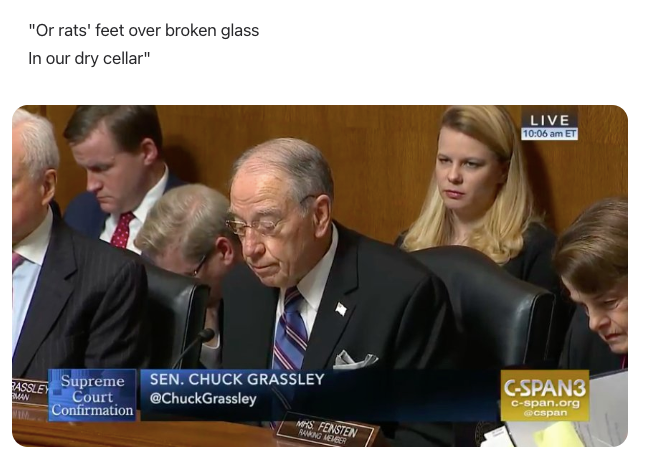
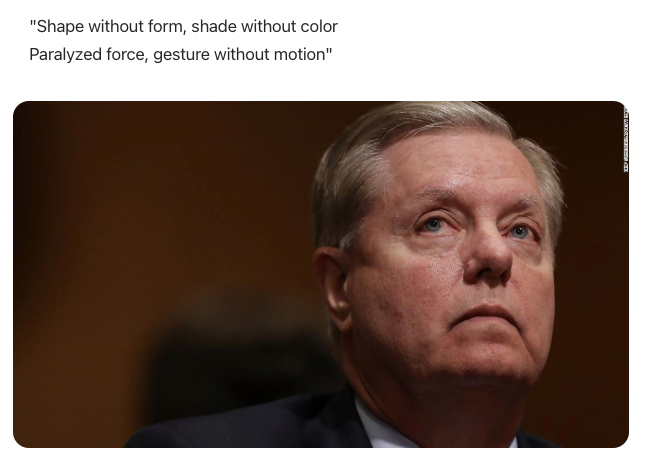
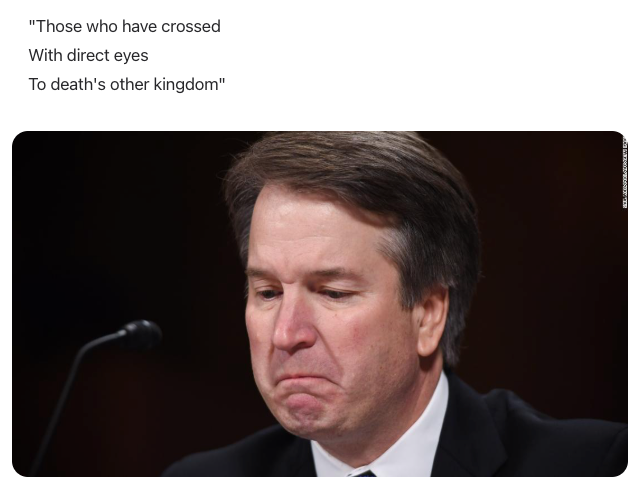
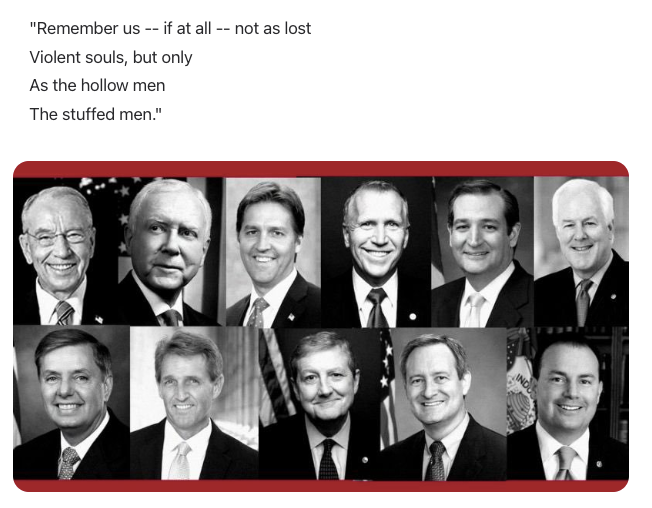
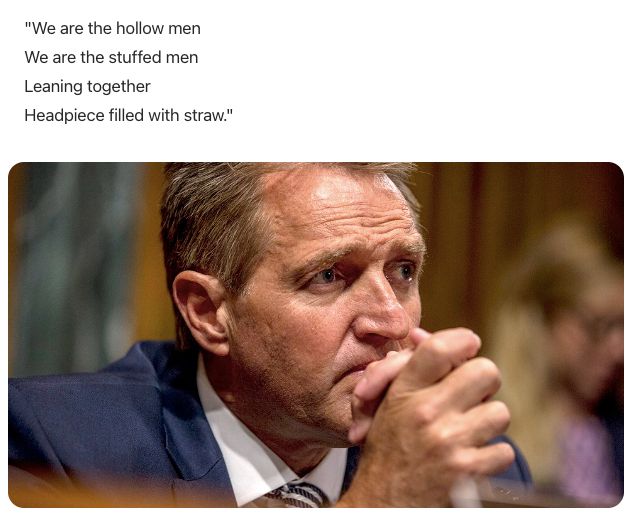
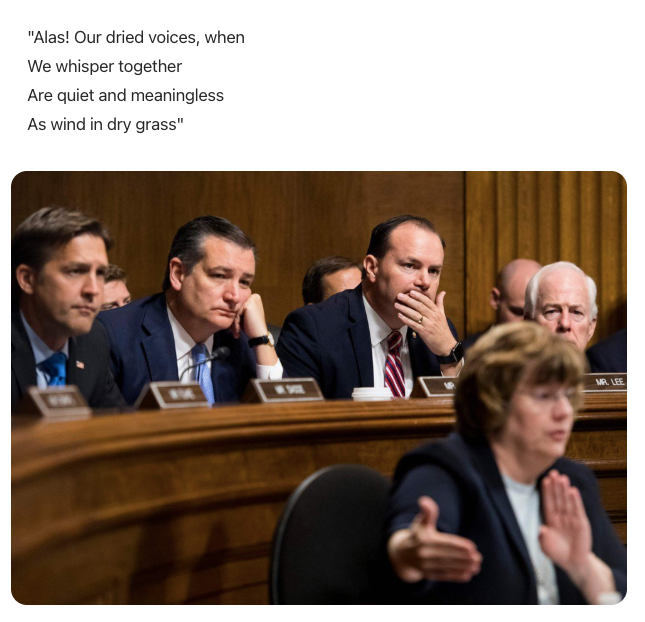
I was reminded recently of another tweet Sarah Kendzior posted at the time of the Kavenaugh hearing. In his Washington Post op-ed Trump must be removed. So must his congressional enablers, George Will referenced the T S Eliot poem The Hollow Men. Skewering the Republican Congressmen, Kendzior posted verses from that poem along with images of those pretending to engage in the Kavenaugh accusations at hand, but were obviously not. This was the first time I had heard the poem and it was a moving introduction.

Updated 20 Jan 2026

Whenever I want to go back and read Kendzior’s thread I’m reminded that Twitter is garbage and won’t let you read threads unless you log in. Retrieved from UnrollNow:
People I now dislike that I once felt the opposite, making me kind of a hypocrite

Richard Dawkins has gone from anti-religious to obliviously prejudiced. I know I know, he’s always been dismissive of religion, and I still agree with much of his attitude, but after this tweet:

He leaves me with a certain ickyness. And you can’t ignore the seemingly clueless ending question. His response to criticism of that tweet contained further cluelessness:

Sam Harris has always been problematic for me. I liked some of his writing at the time of the New (Angry) Atheist movement that came into being 5-or-so years ago, but even then he had–like Dawkins–a little too specific an anger for Islam as opposed to Islam’s cruelly manic adherents. And I unfortunately was introduced to his podcast via his Jordan Peterson interview [ed. blech]. Needless to say etc., it didn’t hook me.

Glenn Greenwald’s interviews with Snowden and release of documents outlining the craaaazy overreach of our intelligence agencies’ molesting of citizen’s rights were and are to be praised. The “liberated” documents most likely weakened our intelligence community’s power and even safety around the world, but that result must be viewed against the level of their abuses against privacy. Extreme, unchecked power may need a certain lawlessness to be corrected.

Still, his recent whataboutism towards anything America is erratically out-of-balance with reality. His argument that Trump’s position against Germany getting oil from Russia exonerates Trump from any collusion-adjacent crimes is… batshit.

Julian Assange. I had defended him, to a point, when the sexual assault allegations came out. There were many facts around the case that suggested innocence as much as guilt. I haven’t revisited that since and really don’t have the intellectual energy to care. I respect his founding of Wikileaks and, like Snowden’s document leak, believe there’s a need for such David/Goliath levelings of playing fields. Now, both he and Wikileaks are likely being manipulated by Russia to serve their ends. Are there truths in the releases? Certainly. Was there manipulation before? Most likely. And yet today the releases are used to attack considerably lesser evils with a laser-guided adherence to the media cycle and in support of a barbarous regime. To a certain degree, David has become Goliath.

Still, I’m a little bit hypocritical.

Not like us

I just read the article The evils of Cultural Appropriation recommended from Arts & Letters Daily. This was the same day that Scarlett Johansson quit her future role in a move where she would have played a transgender man.

The appropriation article–very good, by the way–brought up the history of sumptuary laws which, dating back to BCE civilizations, describe a social convention of restricting clothing based on social class. No dressing like royals; no dressing above your caste; no specific colors that represent the ruling class. It then went on to discuss the current issue where voices defending equality condemn instances when a group in power (whites) adopt the culture of those not. I remember when we visited Thailand that we were warned not to pose in front of a Buddha and mimic his pose. Our guide said it would be like if someone were to go to a church and pose as Christ in front of representations of him on the cross. Similarly, the article pointed out that the idea of cultural appropriation came from the adoption of others’ religious symbols for profit or, in general, in any way that disrespects it.

Originally derived from sociologists writing in the 1990s, its usage appears to have first been adopted by indigenous peoples of nations tainted by histories of colonization, such as Canada, Australia and the United States. Understandably, indigenous communities have been protective of their sacred objects and cultural artifacts, not wishing the experience of exploitation to be repeated generation after generation.

Again, an act of the powerful over the less so.

The label cisgender came about with the intent of not not labelling hetero males and females and thus treating them as the normal, thus others as abnormal. Cis is a non-chosen type just as gay or lesbian or bi or trans. The cis vs. LGBT+ can be seen as power vs. less so.

Scarlett Johansson has been at the center of two orthogonal issues of cultural appropriation and power dynamics. First, her casting in the role of Motoko Kusanagi in last year’s live action Ghost in the Shell remake (of which I had an opinion). Quite simply, she’s an American/white actress playing the role that was originally a Japanese cyborg, and many had issue with not casting a Japanese actress in the role. Now, she was to play a transgender man from the 70s and many LGBT+ groups were angry. I once saw a play where the same actors, in different acts, swapped characters of sometimes different genders (e.g. a male played Joe and a female Jenny in the first act, then opposite in the second). In that play, an actors’ genders were a meta part of the story (coincidentally, IIRC, about colonial whites in South Africa). Men or women playing ambiguously gendered characters of opposite sex by birth or by reassignment is not like the swapping of roles in that play. Neither is it an example of the power dynamics of Renaissance males-playing-females or, ugh, blackface.

Maybe it’s more like the healthy playing the ill or crippled. Or–to get closer to our discomfort–the mentally abled playing those with disabilities [ed. perhaps I have used crude labels?]. We’re uncomfortable with these situations in a way that we’re not with a non-doctor playing a doctor.

The appropriation article brings up a speech that the author Lionel Shriver gave regarding freedom in fiction for any writer to write any character. I had an epiphany once when a writer (who?) explained the value of novels. They said that in life we only know with certainty what we ourselves think. Others of varied histories are opaque to us. In novels, we get a window into others’ impulses and intention and thus may understand the surface differences we see in real life. This seemed an important point, and possibly why us book folk can be a bit arrogant: by creating greater empathy, there is a greater value as a member of society to read than to not.

The label of “politically correct” has become a pejorative denoting a sort of debilitating consideration toward the different. Conservatives use it as a shorthand for liberal deference to blacks, gays, hispanics, southeast asians, and any with a different culture or social history. It’s an issue of those in power and those or those-historically not. With consternation the use of these polite terms, some conservatives express, in a sort of paradox, that they are victims of political correctness and that they are labeled as shameful based on arbitrary and Victorian-like mores. When is a racist not a racist? When they no longer have power.

One concerning quote that comes later in the appropriation article is about responsibility:

The notion that a person can be held as responsible for actions that he or she did not commit strikes at the very heart of our conception of human rights and justice.

Should there be civil rights laws offsetting a previous imbalance? Should there be reconciliation commissions to ameliorate racial or ethnic violence? Should there be protection laws forcing all citizens to pay taxes for curb ramps and elevators? Should Japan, post World War II, have been barred from having an army?

Transitional periods can be those of caution and conflict. The norm of sensitivity towards those that had less, often considerably less, power in the past is not a weakness, but there is no definitive point where that power has equalized.

There’s a problem here

The tech industry is filled with people who do not respect scientific inquiry.

At most every company I’ve worked for, there have been coworkers who held beliefs that seemed antithetical to what I expect from the tech savvy. I equate tech-specific knowledge with general scientific knowledge, and that hasn’t been the case. Some previous examples that contradicted my expectation: a Young Earth creationist who worked on low-level hardware drivers, a CTO who proudly told the company how his wife prayed for, and contributed to, a fix to some server downtime, another CTO and a lead developer who felt the scientists behind the New Horizons mission “knew nothing,” and the manymany who didn’t believe in anthropogenic climate change. The New Horizons insult coming from programmers about other, better programmers was stunning, but the downtime prayer was particularly insulting since it insulted those who worked long overtime hours to actually troubleshoot and fix the issue. Religion was a key factor in all of these, but it doesn’t diminish my shock at such prejudice coming from tech people. It does diminish pride in my profession.

More recent mania has been coming in the form of junk science beliefs from sources that use loose cherry-picking of data to build a, let’s say, non-canonical picture of the natural world.

One subject discussed was based on the common belief that natural equals good and man-made equals bad–or at least less good. This is a noble savage approach to our interactions with the environment. Do we go through periods on the man-made of over-optimism (early 1900s utopianism or late 1950s plastics/drugs/space mania) and of excessive mistrust (the late 1800s Arts and Crafts movement, the 1960s return-to-nature)? The article Manmade or natural, tasty or toxic, they’re all chemicals … (where the image at the bottom was taken) explains the nuance of categorizing what is healthy and not. The split rings of natural/man-made and their 90-degree rotated overlap with toxic/non-toxic is a clean, clear shorthand for the messy reality. Not exact, but more correct that not. Natural can be deadly and man-made can be healthy.

Similarly, there was a discussion on the health and provenance of current dietary choices. This is a subject frequently examined in American culture through decades and multiply at any point in time… does this obsessive-like behavior exist in any other country? So there’s a documentary called What the Health that criticizes the reasoning behind and validity of common choices of food consumption.

I have not watched it.

I have, however, read the rebuttal from Vox titled Debunking What the Health, the buzzy new documentary that wants you to be vegan. It argues that the documentary is filled with cherry-picked details from WHO research and exaggerations of results. An extended section:

The film is filled with bad gotcha journalism
Abuses of science aside, Andersen also repeatedly engages in poorly executed gotcha journalism in an attempt to suggest patient groups are trying to cover up the truth about diet he’s stumbled upon.

On numerous occasions during the film, he calls these groups, such as Susan G. Komen or the American Heart Association, which he correctly points out often take money from the food industry. He then asks receptionists long-winded and detailed questions about nutrition science. When the receptionists, caught off guard, say they can’t answer his questions, Andersen huffs in frustration, apparently hoping to imply there’s a conspiracy afoot.

In another instance, Andersen interviews an official at the American Diabetes Association who won’t get specific with him on diet because, he says, the research doesn’t support very specific claims. Andersen also reads this as a conspiracy.

There’s no doubt food companies have distorted nutrition science and health research, and have tried to influence health guidelines and the lifestyle advice people get. Patient groups like the ADA and the American Heart Association do have deep ties to industry, as I’ve reported. But Andersen’s pseudo-sting operations are silly and reveal nothing of these facts. They also offer no evidence that disease groups are engaged in a vegan cover-up.

I may just be rigid in my adherence to the rigors of science but, of course, I don’t believe so.

image.jpg

From a position of weakness

Updated 8 Feb 2019

I was having a conversation recently about the pros/cons of the Internet as social media and how it differs from similar forms throughout history.

Means of individual and group communications sent to an audience–one-to-many or many-to-many as opposed to one-to-one–include: the town crier (ancient BCE up to ~1900 CE), the broadsheet (from ~1700 up to its blending into…), newspapers (from 700s CE by Chinese dynastic governments, then privately produced Chinese media ~1580, from 1500s-1700s by the Italian government, from the 1600s throughout Europe and America), magazines (1600s), fanzines (1800s (!) literary to mid- late-1900s pop culture), TV (1900s), Usenet and BBSs (1970s), blogs (1990s), social media (late 1990s).

The original forms were government-controlled with broad distribution, then later forms were introduced for private groups but with smaller distribution, and ultimately company-controlled with a broad distribution. In the last 50-or-so years the ability for individuals to broadcast to a potentially large audience became more widely available. Broad distribution was accessible only to governments at first, then corporations, and finally individuals. The progress from fanzine to blog to social media were the forms that provided that increasing access.

The ability of the individual to communicate to the many equates to the ability to affect their social environment. The older newspaper, magazine, and TV forms contained consumable information that provided little opportunity for the consumer to produce any of that information. The only means were in the form of popularity feedback via advertisements, or that of letters-to-the-editor filtered through the editors themselves. These are considerably constrained forms of influence.

Affecting your environment provides a sense of agency and control and perhaps reduces feelings of increasingly narrower importance in communities that are increasingly wider. Someone in a small town now more likely understands, via the Internet, that they are only part of a near limitless whole. (This understanding is addressed defectively by Jordan Peterson’s romanticizing of “small, rural communities.”)

The ability to affect your environment comes in different forms. Similar to the broadcast of ideas are the choices to spray paint graffiti or play loud music in a public space: the city controls you and so you try to take some of that control back. This gets maybe into the difference of lower class disaffection and response versus middle class response, but that is probably too simplistic. (Even, further afield, the choice to get a tattoo is a choice to control a body that was given without choice.) In the initial discussion that prompted this entry, we also talked anecdotally about how the game Pong amazed us as children and how, obviously, it appears simplistic. From tinker toys to VR Minecraft. Similar to sending your messages to potential millions, controlling what appeared on a TV screen that was previously consumption-only gave the individual control over previously un-controlled content. The thrill of making dots on a TV screen do what you want comes from the same source that drives us to post a picture of food on Instagram or pass along our belief in a government conspiracy on Facebook. Within every success is a failure.

Updated 8 Feb 2019

Origins of journalism and conservative hatred of journalism in The New Yorker article Does Journalism Have a Future?

Correcting/clarifying my loose reading of Wikipedia history, newspapers qua American newspapers started in the 1830s. Hatred of news by conservatives started earlier than I expected: in the 1950s with McCarthy and heavily in the 1970s by Spirow Agnew (who I recently/embarrassingly just learned was Nixon’s VP pre-Ford and resigned prior to Nixon in a nearly-as-corrupt cloud). He states that “good politics for us to kick the press around” which sounds grindingly similar to Trump’s “fake news” quips”. But we knew that?

And there’s a satisfaction that Bill Kristol denounced the press at the time as fake-news-ish and then the shuttering of the iconic magazine he founded, The Weekly Standard, was celebrated by Trump. What Rick Wilson keenly calls “Everything Trump Touches Dies” I express as a canonical example of a monster eating its creators. Good. Fucking. Riddance. Hate begets destruction.

Notes:

  • Jour means day, newspapers were daily, journalism
  • TV made newspapers from descriptive to interpretive since tv was visually descriptive

In No thank you, Mr. Pecker, Jeff Bezos reveals that The Enquirer attempted to blackmail him in order to have the newspapestarter he owns (the notable WaPo) stop pursuing stories re their (The Enquirer’s) politically-motivated catch-and-kill activities w/r/t Trump. Representatives for the not-so-notable Enquirer spoke to him about photos they found (“found” being key) with him naked and/and genitally erect with a woman-not-his-wife while wearing his wedding ring, and then sent him emails (holy shit wire fraud!) saying same. He published their threat and the content thereof. Billionaires are justifiably getting shit right now, but his response as the billionaire was satisfying in a hero-we-need way:

Any personal embarrassment AMI could cause me takes a back seat because there’s a much more important matter involved here. If in my position I can’t stand up to this kind of extortion, how many people can?

Jacques Peretti, post modernist, then started Buzzfeed.

Arianna Huffington was anti-feminist

Alan Rusbridger from The Guardian:

Our Generation had been handed the challenge of rethinking almost everything societies had, for centuries, taken for granted about journalism.

This is untrue. Journalism has always been mutable, but we just forget.